
Golf is a unique sport played in a wide range of semi-natural environments. Unlike other sports that take place in indoor facilities or uniform outdoor grass fields and stadiums, golf courses include diverse landscapes and ecosystems, including water features such as streams and ponds, and woods and tall grasslands bordering fairways, which golfers frequently interact with while playing their sport (Lewitus et al., 2003; Powell et al., 2003). These natural features provide permanent habitats for numerous wildlife and offer appealing seasonal refuge for migratory birds (Timmer, 1995). Ponds pose a particular risk as potential sources of contamination (Lewitus et al., 2003), a risk that may be heightened by the use of greywater for irrigation on some courses (Alonso et al., 2006). Greywater is wastewater from showers, sinks, and other common household sources that are used for irrigation but not treated by a public water treatment facility (Hamidi, 2025).
A possible concern in environments like this is the presence of coliform bacteria which are Gram-negative rod-shaped bacteria. Coliforms are commonly found in both the environment and the intestinal tract of mammals. Fecal coliform is the subset of those coliforms that are specifically found in the intestinal tract (and therefore fecal matter) of mammals, including humans. E. Coli is a specific fecal coliform. The more natural environmental conditions of golf may increase the likelihood of exposure to fecal coliforms, which indicate fecal contamination. Migrating birds frequently leave droppings on greens, fairways, and near water features (Kassa et al., 2001; Powell et al., 2003). Golf balls, club heads, and shoes come into frequent contact with these areas. Since golfers handle this equipment before, during, and after gameplay, they may unknowingly expose themselves to these bacteria.
To further exacerbate the issue, golfers also commonly engage in hand-to-mouth behaviors during their round that may aid the transmission of contaminants. Some golfers develop the habit of placing tees in their mouths, wiping dirt and other debris off their golf balls with their fingers, and eating food during their round. Hand-held foods such as hot dogs, sandwiches, and hamburgers are popular items sold in golf clubhouses and halfway houses (Kaspriske, 2015). Recommended snacks include sandwiches, dried fruits, peanuts, and trail mix; all of which are typically eaten in a hand-to-mouth manner, increasing the likelihood of directly ingesting fecal coliforms that may be present on one’s hands. Often, there is no opportunity to wash hands during a game of golf, increasing the likelihood of ingesting contaminants on hands or equipment.
The purpose of the study was to evaluate whether golfers are exposed to fecal coliform bacteria during a typical round of golf. It was hypothesized that the presence of fecal coliforms on golfers’ hands and equipment would be significantly higher after a round of golf compared to before, due to environmental contact. In addition, the authors posit that golfers will report frequent hand-to-mouth behaviors which heighten their risk of coliform exposure.
Method
Participants
A convenience sample of nine golfers from a local golf course was recruited. In compliance with the Institutional Review Board recommendations, no demographic information was taken on the golfers. Participation was voluntary, and informed consent was obtained. Each participant received a new golf glove as compensation for study participation.
Sampling Procedure
To assess exposure to coliform bacteria, the research team collected samples from golfers’ hands and equipment using sterile techniques. Samples were taken both before and after a round of golf. Specifically, Liquid Amies Elution Swabs (ESwab) and 3M™ Petrifilm™ E. coli / coliform count plates were used to collect and cultivate samples. 3M™ Petrifilm™ E. coli/coliform count plates are commonly used to enumerate E. coli and non-E. coli coliforms from a variety of sources. Prior to the round of golf, a research team member used a sterile swab to swab each golfer’s non-gloved hand, new golf glove, old golf glove, and three pockets of the golf bag. One golfer reported not using a glove, so the research team could not swab his current glove. However, the golfer agreed to wear the new glove for the current round to enable post-round sampling.
Following the round of golf, a research team member collected swabs from each golfer’s non-gloved hand and the new golf glove worn during the preceding round. In total, 54 samples were taken from the golfers and their equipment. Samples were also taken from the men’s and women’s bathroom floors for comparison. All swabs were placed directly into an ESwab medium transport tube, sealed, labeled, and stored in a cooler until analysis. Swabs were transported to the laboratory for processing, which was completed within two hours of the completion of the round of golf. The samples were taken approximately six months after the groundskeepers applied fertilizers to the fairways and one month after applying fertilizers to the green to minimize the possibility of obtaining elevated samples.
Sample Processing
Each swab was immersed in a liquid and centrifuged to produce a 1mL sample. This sample was then plated on 3M™ Petrifilm™ E. coli/Coliform count plates, a selective medium that limits growth primarily to Gram-negative bacteria, and provides a mechanism to visualize gas production, allowing for easy detection of coliforms. Additionally, the media includes a chromogenic substrate (5-bromo-4-chloro-3-indolyl-D-glucuronide or BCIG) to differentiate E. coli from other coliforms.
The plates were incubated at standard conditions for 48 hours. Colonies were then rapidly identified and enumerated to assess the presence and quantity of total coliforms and E. coli. These results indicated unsanitary conditions and potential risks of coliform exposure.
Survey Instrument
Participants completed a brief 11-item survey designed by the research team to examine golfers’ behaviors related to coliform exposure (see Appendix). Items focused on how long they have owned their equipment, playing frequency, equipment cleaning habits, and hand-to-mouth behaviors while golfing (e.g., eating, licking fingers, putting tees in the mouth). A descriptive statistical analysis was performed, including mean (M) and standard deviation (SD) with frequency of response represented as a percentage.
Results
All the golfers indicated they were recreational golfers, with eight out of the nine golfers indicating they played golf within the last week (88.89%), and one (11.11%) reporting playing 14 days ago. There was substantial variability in the reported number of days and rounds of golf played with the current gloves. One golfer (11.11%) reported not using a glove, and four (44.44%) were unable to estimate how long they owned their glove or how many rounds they played with it. Current glove ownership (M = 68.75, SD = 78.61 days) and number of rounds played (M = 15.00, SD = 23.57) varied greatly across the remaining respondents, with 180 days of ownership and 50 rounds being the highest values reported, and one day of ownership and one round of golf being the lowest values reported. The golfers sampled reported owning their bag for 2.5 years (SD = 1.5 years) and playing an estimated 129 rounds of golf (SD =103) with their current bag. None of the golfers indicated they had ever cleaned their bag or current glove.
A total of five (55.56%) of the golfers’ hands or equipment (e.g., glove) tested positive for at least one coliform. Only one sample taken before the round of golf tested positive for coliforms. The golfer reported playing golf the previous day, and their glove tested positive for fecal coliforms. In comparison, four (44.44%) of the golfers’ hands or gloves tested positive after the round. None of the golfers’ bags tested positive for coliforms prior to or following the round of golf. Notably, in one case, more coliforms were found on a golfer’s hand following the round of golf than were found in the sample taken from the public bathroom floor at the same facility.
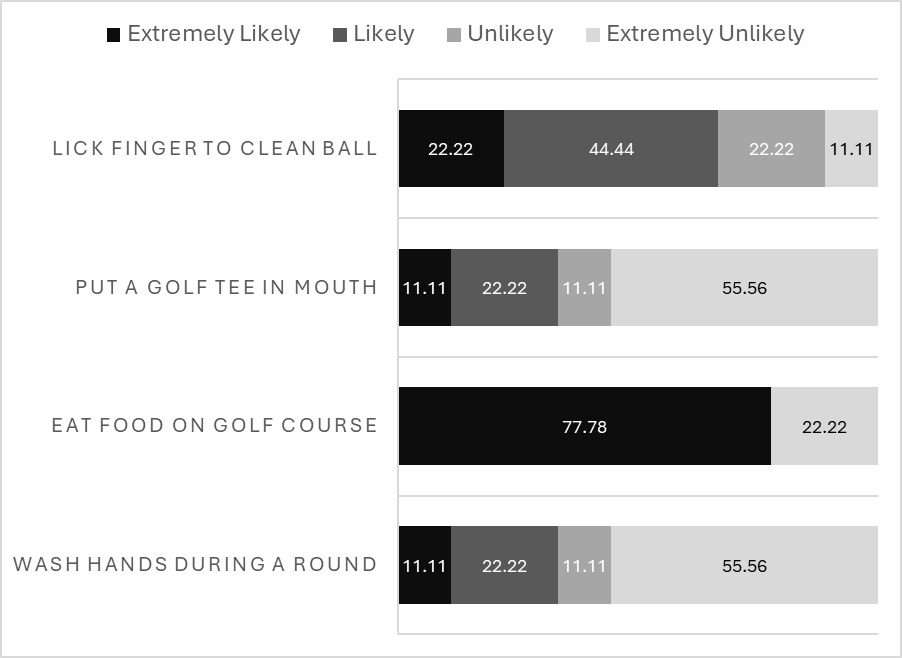
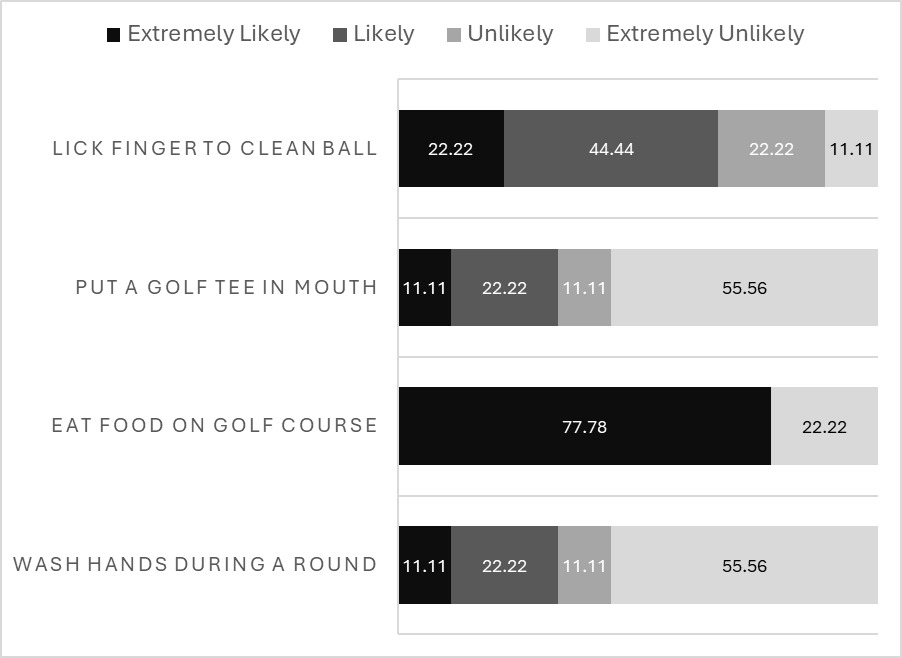
Results from the survey further illustrate the frequency of behaviors that may increase the chance of bacterial ingestion. See Figure 1.
Discussion
This study provides preliminary evidence that recreational golfers are regularly exposed to fecal coliform bacteria through environmental interactions and game-play behaviors. More than half of the golfers’ hands tested positive for coliforms. Although numerous studies have measured coliform levels on golf courses (Kassa et al., 2001; Powell et al., 2003), this is the first study to demonstrate the transfer of coliforms to golfers and their equipment.
It is important to note the conditions under which positive samples were found. None of the samples taken from the golfers’ bags tested positive, and only one sample taken from the golfers’ equipment prior to the round of golf tested positive. The lack of positive tests on golfers’ equipment aligns with the life span of coliforms. Coliforms and fecal coliforms can live for weeks in fields, and even longer in streams (Perry, 2011). However, most die within 20 minutes to a few hours on hard surfaces, although Clostridioides difficile can live for months (Cleveland Clinic, 2022).
While many golfers reported being unlikely to wash their hands or clean their glove during a round, they also reported being likely to engage in hand-to-mouth behaviors, such as licking their fingers to clean the golf ball or holding the tee in their mouth. Golfers also frequently eat finger food while playing, further elevating their chances of ingesting coliform bacteria. These self-reported behaviors, when considered alongside the coliform findings, strongly suggest that golfers are likely to be exposed to fecal coliforms during a round of golf. The results of this study indicate that golfers should engage in healthy habits and routinely clean their hands during play. Golf course operators and athletic departments should raise awareness and educate golfers about the presence of coliforms and the likelihood of exposure.
For most people, the adverse effects are limited to stomach cramps, diarrhea, and low fever (CDC, 2024b). Stomach acids are typically strong enough to kill most bacteria (Smith, 2003). However, certain subpopulations are more susceptible to the more extreme adverse effects of fecal coliforms (Cleveland Clinic, 2023). Increased awareness may be particularly important for golfers who are elderly, immunocompromised, or infected with a respiratory infection or gastrointestinal disease since their bodies are less effective at combating pathogens (Smith, 2003).
Golf courses do take some precautions. For example, the most widely used fertilizer undergoes a process to remove fecal coliforms from its product, and research suggests golf courses increase downstream nitrates but not fecal coliforms (Mallin & Wheeler, 2000). The United States Environmental Protection Agency issued guidelines for the reuse of reclaimed water (USEPA, 2004).
To reduce exposure, golfers may consider ways to reduce the bacterial load. Access to handwashing facilities is limited on most golf courses. Hand sanitizers are recommended to reduce bacterial load when handwashing facilities are unavailable (Boyce & Schaffner, 2021). However, hand sanitizers do not effectively remove all types of germs and chemicals, like pesticides, that may be present on hands. As such, the CDC (2024a) recommends washing hands rather than using hand sanitizer whenever possible. Although this study did not focus on pesticides, additional research is needed to examine whether golfers experience increased pesticide exposure (Gilden et al., 2012). Recent research has found an association between living in proximity to a golf course and an increased risk of developing Parkinson’s disease (Krzyzanowski et al., 2025). Warm water and soap can effectively remove a wider range of potentially harmful substances that golfers may encounter during a typical round, making them a preferred method of sanitization. In concert with other studies designed to promote healthy habits and mitigate injuries in golf (Meira & Brumitt, 2010; Thériault & Lachance, 1998), the authors recommend golfers bring a towel dampened with mild soap for routine hand cleaning between holes.
There are several limitations with the current study. The results are based on a small sample of golfers from a single golf course in the Southeastern United States. Even though this study was conducted at only one golf course in the Southeastern United States, it is reasonable to assume that some coliforms are present at golf courses worldwide. Wildlife and water features are primary sources and breeding grounds for coliforms and are present in most courses worldwide. Additional research should be conducted to examine variability in coliform levels across seasonal migration, climate, and local ecosystems. While the sample size is adequate for biologically based environmental studies, it may be worthwhile to perform similar studies with golfers of varying levels of expertise. The current study was limited to recreational golfers. Future studies of this kind could examine whether professional and collegiate golfers have increased exposure to fecal coliforms due to more frequent play than recreational golfers, or whether this is offset by the ability to change equipment more often than recreational golfers, owing to sponsorships.
There are many benefits to playing golf, including increasing cardiovascular health, balance, and mental health (Murray et al., 2017; Sorbie et al., 2022). The authors strongly encourage individuals to participate in golf, however, all physical activities have both risks and benefits, and increasing awareness is a vital component of promoting healthy behaviors. This is the first study to demonstrate a direct link between playing golf, frequency of hand-to-mouth behaviors, and exposure to coliforms. The authors aim to raise awareness of the conditions present on golf courses and urge golfers to adopt best practices to mitigate exposure to coliforms and other potential contaminants during play. Due to the amount of wildlife, pesticides, fertilizers, and other potentially harmful substances on the course, it is recommended that golfers clean their hands more frequently during gameplay.
DISCLAIMER
The views expressed in this manuscript are those of the authors.
CONFLICTS OF INTEREST AND SOURCE OF FUNDING
The authors have no competing interests to declare. This study was funded by the Research Scholarship and Creativity Activity Program of Augusta University.
ETHICAL APPROVAL
The study had ethical approval from the Institutional Review Board of Augusta University, Augusta Georgia, USA. IRB APPROVAL NUMBER [906477-2] The Presence of Coliforms and Fecal Coliforms in a Sports Environment